

Table of Contents
- Why Simplified Project Delivery Matters for Renovation and Construction
- AI in Construction Project Management: What It Actually Changes
- AI Construction Project Management Tools Worth Knowing
- AI for Renovation Companies: Practical Applications on Site
- Construction Project Delivery Best Practices in an AI-Assisted Workflow
- What to Ignore: Common Bad Advice About AI in Construction
- Conclusion
- Frequently Asked Questions
Last Updated: 21 October 2026
Why Simplified Project Delivery Matters for Renovation and Construction
Streamlined project delivery is the practice of removing friction between design decisions, trades and site progress so a fit-out finishes on the date it was promised. At Anderston Group, we build interior fit-outs for hospitality, commercial and industrial clients, and we treat delivery speed as a design constraint rather than an afterthought. A stripped-out bar sitting empty costs its operator money every single day it stays that way. The UK government guidance on building regulations approval sets out how much of a fit-out is gated by inspection and sign-off, which is why sequencing matters as much as craftsmanship.
AI in Construction Project Management: What It Actually Changes
AI in construction project management changes three things: how fast a programme is updated, how early a risk surfaces, and how much of a project manager's week goes on chasing information. It does not pour concrete or hang a door.
The realistic gains sit in administration and foresight. A project manager who previously rebuilt a schedule by hand every Friday can have a live programme instead. The trade-off is that any AI output is only as good as the data going in, and a half-completed site diary produces confident nonsense.
AI Construction Project Management Tools Worth Knowing
AI construction project management tools fall into two groups: those that plan the work and those that watch the money. Most fit-out contractors need one of each, not five of both.
Scheduling and Resource Planning
Scheduling tools take a programme and re-sequence it when a trade slips. Feed in the joinery and M&E dependencies and the software will flag that a delayed first fix pushes second fix, decoration and handover in that order. The value is in the cascade, not the Gantt chart. Where these tools earn their keep is multi-site rollouts, where one crew's overrun affects three other jobs.
Cost tracking and risk flagging
Cost tools compare committed spend against budget and flag variance early. On a fit-out, the useful signal is a variation order raised on day three that quietly doubles a finishes allowance. Catching that in week one is recoverable. Catching it at practical completion is a difficult conversation.
| Tool type | What it does well | Where it falls short | Best for |
|---|---|---|---|
| Scheduling platforms | Re-sequences dependent trades automatically | Needs daily site input to stay accurate | Multi-site rollouts |
| Cost and risk trackers | Flags budget variance early | Poor at capturing verbal variations | Projects with heavy client changes |
| Document control | Single source for drawings and revisions | Adds admin if not adopted fully | Complex listed buildings |
| Snagging apps | Photographic defect trails by location | Only as good as the inspector | Handover-heavy fit-outs |
AI for Renovation Companies: Practical Applications on Site
AI for renovation companies earns its place in four practical jobs: turning a site walkaround into a task list, comparing as-built photographs against drawings, drafting variation records, and forecasting which trade will be needed next.
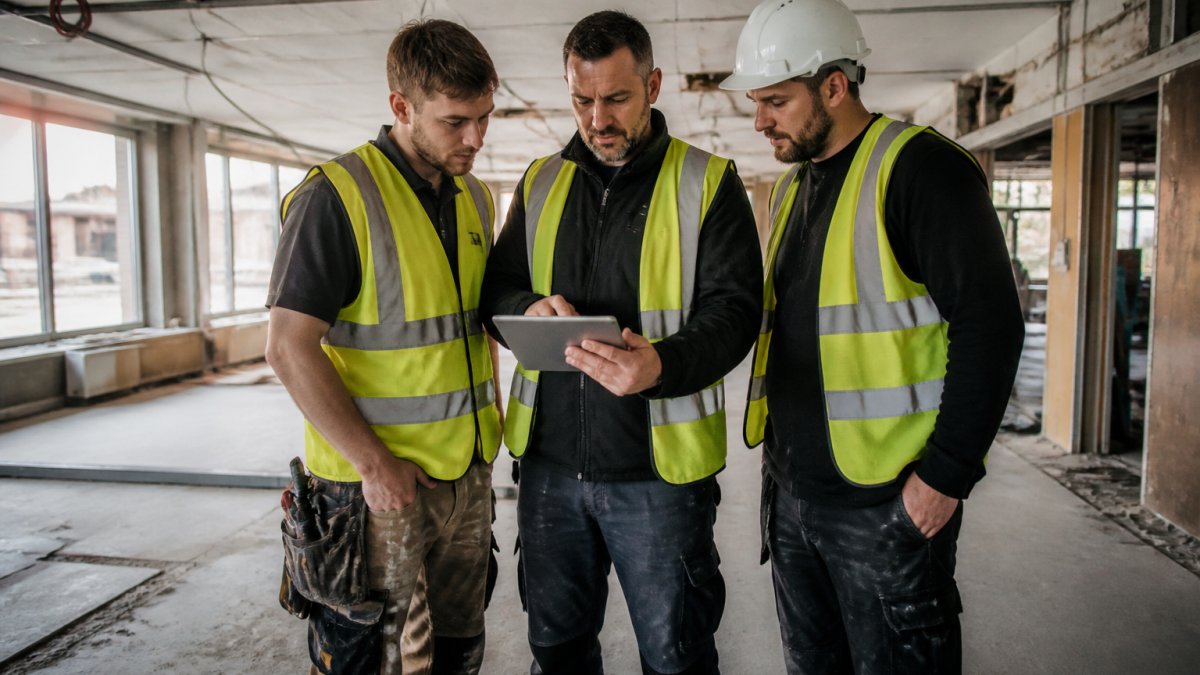
The honest limitation is listed and heritage work. A drawing tool cannot interpret a hidden beam or a party wall agreement. On older buildings, the survey still has to be done by a person with a ladder and a torch.
Construction Project Delivery Best Practices in an AI-Assisted Workflow
Streamlined project delivery best practices do not change because software arrived. What changes is the speed at which good practice can be enforced. Our approach follows four rules:
- One named owner per site for programme updates, agreed before mobilisation
- Daily site diary completed before anyone leaves, no exceptions
- Every variation logged in the system the day it is raised, not at month end
- Weekly programme review with all trades present, in person or on a call
- Photographic record of every element before it is covered up
- Single document register, with superseded drawings archived not deleted
The single biggest lever is co-location of trades. When joinery and M&E sit in the same weekly review, the "they weren't talking to each other" problem that derails so many fit-outs stops being possible. Software supports that discipline; it cannot replace it. The Health and Safety Executive guidance on construction site management is worth reading alongside any digital workflow, because no platform removes your duty to manage risk on site.
What to Ignore: Common Bad Advice About AI in Construction
Bad advice about AI in construction usually sounds like a promise to remove people from the process. Ignore anything that suggests a platform will run a fit-out without a competent project manager, a site supervisor and trades who turn up.
Three specific claims to treat with suspicion. First, that AI eliminates the need for site visits. Second, that a single tool covers scheduling, cost, snagging and compliance. Third, that historic project data will predict your next programme before anyone has surveyed the building. None of these hold up on a live site.
Conclusion
Every week a space sits empty is a week of rent with nothing coming back, and no platform fixes that on its own. What closes the gap is a team that owns the programme, keeps the record current and has the trades in-house so the handoffs stop getting lost. Anderston Group runs an AI-native project management engine alongside in-house M&E, joinery and metalwork, giving you one point of contact from design through to handover. Get started with Anderston Group and put a delivery date on the wall that actually holds.
Frequently Asked Questions
How is AI used in construction project management?
AI is used to automate scheduling, track costs in real time, flag risks, and coordinate trades. It analyses project data to predict delays, suggest resource reallocation, and keep all parties aligned. For example, an AI tool can compare progress photos against the programme and alert the project manager if a trade is falling behind, allowing corrective action before the critical path is affected.
Can AI help manage a property renovation project?
Yes. AI helps manage renovations by improving coordination between trades, tracking variations, and providing early warnings of budget overruns. It is particularly useful for projects with complex sequences, such as listed building works, where unexpected discoveries are common. AI systems can document changes, update programmes automatically, and keep clients informed, reducing the risk of costly misunderstandings.
What are the benefits of AI in construction?
The main benefits include faster decision-making, fewer delays, better cost control, and improved communication. AI reduces manual reporting, highlights risks earlier, and helps teams stay on programme. On fit-out projects, this can mean less downtime and fewer disputes. It also supports compliance by keeping digital records of inspections and changes, which is valuable for building control and client sign-off.
How can AI improve construction project delivery?
AI improves delivery by predicting bottlenecks, automating routine admin, and giving project managers real-time visibility. It can simulate different sequences to find the most efficient schedule, track material deliveries, and flag when a trade is likely to miss a deadline. This allows the team to act before delays cascade, keeping the project on track and within budget.
Which AI tools are used in construction project management?
Tools range from AI-enhanced project management platforms with scheduling and cost modules to specialised risk analysis and document management systems. Many contractors use AI features within established platforms to forecast delays and automate reporting. When evaluating tools, consider integration with your existing workflows, data security, and the level of support provided.
Can AI help reduce delays in renovation projects?
Yes. AI reduces delays by identifying risks early and suggesting mitigations. For instance, it can analyse historical data to predict which activities are most likely to slip and recommend buffer time or additional resources. It also improves coordination by ensuring all trades are working from the latest information, reducing the chance of rework and standoffs.
What should a business consider before adopting AI for a construction project?
Consider data quality, team training, integration with existing systems, and the specific problems you want to solve. Start with a pilot on a smaller project to test the tool and build confidence. Also assess the vendor's support and the tool's ability to handle UK-specific regulations and standards. Ensure you have clear processes for data entry and review so the AI outputs are reliable.